Automated technical debt repair has emerged as a cornerstone for modern engineering teams looking to maintain high-velocity software delivery without compromising code quality. However, building a system that automatically scans massive enterprise codebases, identifies deeply buried technical debt, and uses advanced artificial intelligence to generate production-ready pull requests demands more than a basic script. It requires a system that is resilient, highly scalable, and completely decoupled.
This technical brief takes you under the hood of DebtDrone to explore its architecture. We'll show how a simple code commit seamlessly transforms into a fully documented, AI-generated pull request — all while maintaining the strict security boundaries required by enterprise organizations.
The Big Picture: A Decoupled Ecosystem
To understand DebtDrone's fault tolerance, it helps to visualize its separation of concerns. The platform is engineered so that no two primary components communicate with each other directly. Instead, a strict asynchronous boundary governs the entire system.
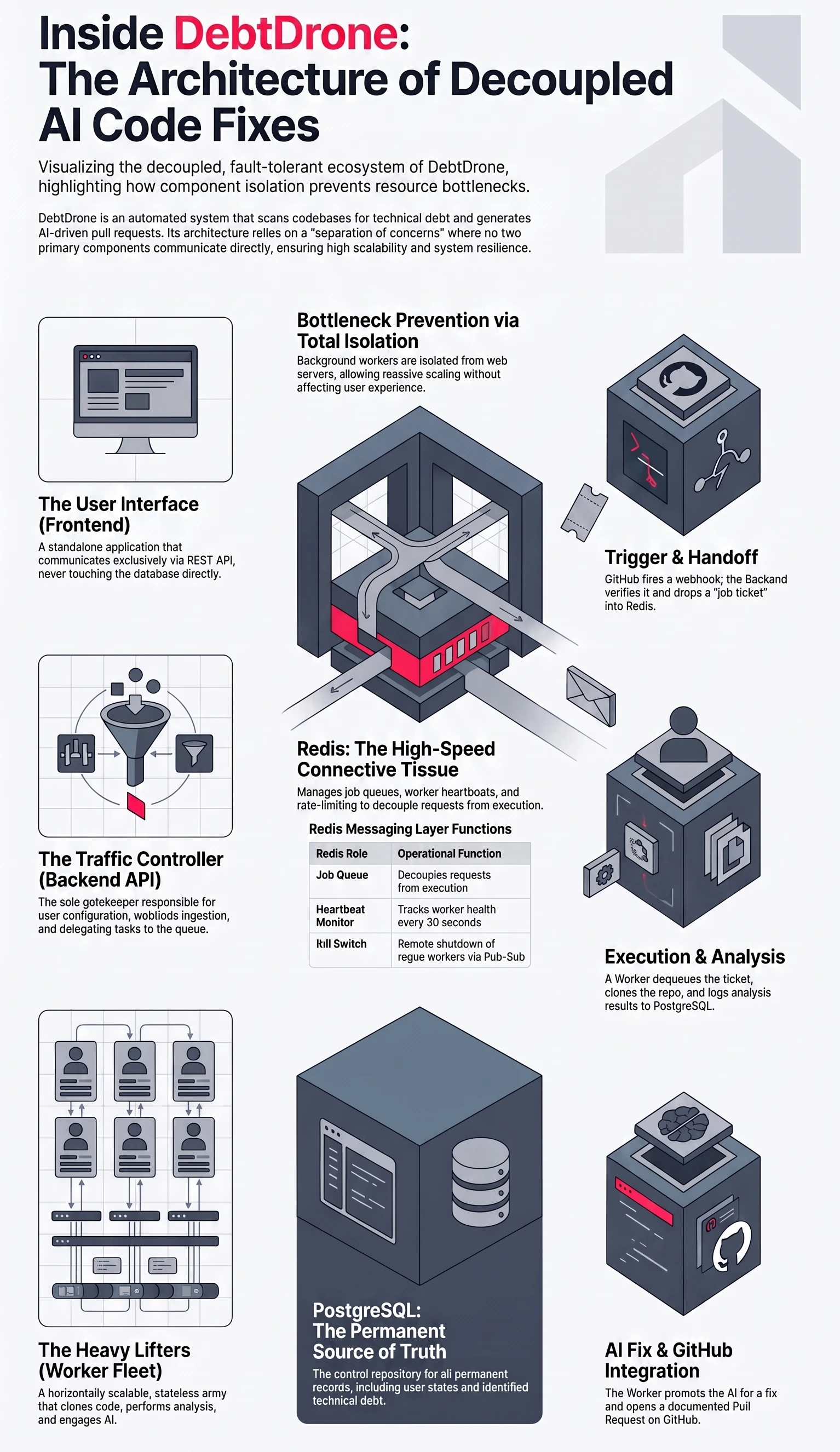
This strict decoupling is DebtDrone's primary architectural strength. Because the frontend interface never touches PostgreSQL directly, and the background workers never communicate directly with the web servers, the system is immune to traditional resource-exhaustion bottlenecks.
The Three Core Moving Pieces
1. The User Interface (Frontend)
The user interface is built as a modern single-page application. Its sole responsibility is rendering an intuitive, responsive user experience. It communicates exclusively with the backend via secure REST APIs. Whether an engineer is viewing connected repositories, browsing identified technical debt, or reading AI notifications, every data point on the screen is securely retrieved and formatted by the backend API.
2. The Traffic Controller (Backend API)
The backend API serves as the gatekeeper and central traffic coordinator. It's the only component authorized to interact with PostgreSQL and Redis from the user-facing network. Its core operational duties include:
- Access and configuration — managing user authentication, enterprise permission boundaries, billing states, and secure integrations with third-party issue trackers like Jira and Trello.
- Webhook ingestion — serving as the secure, high-availability landing pad for webhook events fired from GitHub.
- Asynchronous delegation — when a repository requires a technical debt scan, the API doesn't perform the heavy computation itself. Instead, it drops a "job ticket" into Redis and instantly returns a success status, freeing up web server threads to handle subsequent requests.
3. The Heavy Lifters (Worker Fleet)
The worker fleet is a horizontally scalable, stateless army of background processes. Each autonomous worker constantly monitors the job queue for new tasks. When a worker dequeues a job, it executes a five-step pipeline:
- Clone — it securely pulls the target repository from GitHub.
- Analyze — it runs a comprehensive analysis pass, evaluating lines of code, calculating cognitive complexity, and scanning for security vulnerabilities.
- Persist — it logs all identified technical debt and static analysis metrics directly into PostgreSQL.
- Resolve — it prompts the AI layer — Gemini as the primary model, with automatic failover routing to Groq and NVIDIA-hosted models — to synthesize an optimal code fix for the discovered issues.
- Deliver — it automatically opens a structured, fully documented pull request directly on GitHub, while optionally syncing the action to Jira or Trello.
Redis and PostgreSQL: The Infrastructure Backbone
While traditional systems view databases merely as storage repositories, DebtDrone relies on them to act as active operational coordinators.
Redis: The Central Nervous System
This high-speed in-memory store acts as the connective tissue of the system, fulfilling five distinct roles to maintain smooth operations:
| Operational role | Functional purpose |
|---|---|
| Job queue | Decouples webhook ingestion from execution, letting background workers process code changes at their own pace. |
| Heartbeat monitor | Workers ping Redis every 30 seconds. If a worker goes silent, the administrative dashboard flags it as offline. |
| Kill switch | Allows system operators to gracefully or forcefully terminate specific worker processes remotely via a pub/sub channel. |
| Rate limiter | Protects the backend APIs from traffic spikes and secures authentication endpoints against brute-force attacks. |
| Deduplication cache | Caches webhook event IDs to prevent duplicate execution if GitHub resends an event. |
PostgreSQL: The Permanent Source of Truth
Any data that must outlive a single transaction resides in PostgreSQL — the single source of truth for the entire platform. It retains all long-lived state, including:
- User configurations, team permissions, and billing records.
- The exact file paths, line numbers, and categories of technical debt discovered during worker scans.
- Full historical logs of AI-generated code resolutions and downstream feedback.
Step-by-Step: The Lifecycle of an AI-Generated Fix
To appreciate the efficiency of this decoupled topology, we can trace a single code change as it moves through the system:
- The trigger — a developer pushes a code commit to GitHub.
- The handoff — GitHub fires a webhook event to the DebtDrone backend. The backend verifies the signature, generates a job ticket in Redis, and immediately replies with a 202 Accepted response.
- The execution — an available background worker claims the ticket, clones the codebase, runs the static analyzers, and writes the results to PostgreSQL.
- The AI fix — the worker calls the AI engine to resolve the technical debt, then interacts with the GitHub API to open a new pull request containing the corrected code and a clear explanation.
- The reveal — the next time the developer opens their dashboard, the new issue, explanation, and pull request are waiting for them, pulled instantly from PostgreSQL.
Architectural Benefits for Enterprise Scaling
Deploying this decoupled, stateless architecture yields substantial operational advantages for enterprise teams:
- Fault tolerance — if the worker fleet scales down or undergoes maintenance, webhook ingestion continues uninterrupted. Incoming jobs are simply buffered in Redis.
- Horizontal scalability — background workers are completely stateless. As a result, organizations can spin up many concurrent worker instances during peak code-audit sprints without modifying web APIs or database layers.
- Strict security isolation — source code is cloned and processed exclusively within isolated worker containers. No proprietary code is ever exposed to the public-facing API or stored in persistent web caches, aligning with global compliance and data security mandates.
By enforcing complete isolation between concerns, DebtDrone guarantees that your engineering team can focus entirely on what matters most: reviewing and merging optimized, AI-delivered code fixes.